
The Jew Under Glass: Museums, Memory, and the Politics of Jewish Absence


I have recently begun researching a question that first appeared to me not in an archive, but while walking.
I have walked through the Venetian Ghetto, where the word ghetto entered the political vocabulary of the modern world. The synagogues remain. The buildings remain. Plaques explain the restrictions once imposed upon Jewish life. Tourists move through narrow streets, take photographs, listen to guides, and encounter the Jew as a historical presence. Yet the strange impression is unavoidable: Jewish life appears everywhere in the past tense.
I felt something similar in Egypt. Synagogues have been restored and presented as evidence of a once-cosmopolitan society, but almost no Jews remain to worship in them. The buildings survive under the supervision of the same nation from which an ancient Jewish population largely disappeared. A synagogue may be carefully repaired, polished, guarded, and opened for official visits while the community that gave it meaning exists mainly abroad.
In Prague, Budapest, London, and elsewhere, I encountered different versions of the same contradiction. Jewish cemeteries, Torah ornaments, household objects, photographs, neighborhoods, and destroyed congregations are preserved with extraordinary care. Some of this work is honorable and necessary. Historians, curators, architects, descendants, and local activists have rescued irreplaceable fragments from neglect and destruction.
But preservation presents a deeper question:
Why are some societies more comfortable with Jewish objects than with Jewish people?
That question has become the focus of my current research.
The Jew a Nation Is Willing to Remember
The modern museum does not necessarily erase the Jew. Often, it does something more complicated: it preserves the Jew in the form most convenient to the nation.
The Jew may be presented as:
the medieval merchant
the neighborhood shopkeeper
the musician
the intellectual
the victim of fascism
the vanished citizen of a once-diverse city
the silent face in a Holocaust photograph
These figures are worthy of preservation. The problem begins when the historical Jew becomes a substitute for the living one.
The museum Jew is contained. He has a date, a caption, a display case, and an approved place in the national story. He cannot demand the return of property. He cannot dispute the exhibition label. He cannot object when his religion is reduced to folklore. He cannot argue about Israel, Zionism, security, sovereignty, or the historical circumstances that made Jewish statehood necessary.
The living Jew is much less convenient.
The living Jew may ask who owns the Torah in the glass case. She may ask why a restored synagogue has no congregation. He may ask what happened to the families whose furniture, books, businesses, and homes became the property of other citizens. Jewish descendants may want access to archives, ownership records, cemeteries, or communal buildings. They may resist national histories in which antisemitism always came from somewhere else.
They may also believe that Jewish survival requires more than memorials.
This is where the tension begins.
The Jew Under Glass

I have started using the phrase "the Jew under glass" to describe this institutional transformation.
The glass case preserves the object, but it also immobilizes it. It places a boundary between the observer and what is observed. The object may be respected, studied, photographed, and admired, but it cannot answer back.
Museums do something similar with human histories. They do not simply display the past. They classify it. They decide which objects belong together, which dates mark the beginning and end of a story, whose interpretation appears on the wall, and what political meaning the visitor should carry into the next room.
The French thinker Michel Foucault wrote extensively about institutions that organize knowledge and visibility. The prison, clinic, school, archive, and asylum do not merely respond to already existing categories. They help manufacture the categories through which society understands people. The museum belongs to this institutional family. It teaches the public what can be seen, how it should be named, and which version of the past appears reasonable.
Applied to Jewish history, the museum asks more than, "What happened to the Jews?"
It also answers a quieter question:
What kind of Jew is this society willing to recognize?
Frequently, the acceptable Jew is the Jew of memory rather than politics, the Jewish victim rather than the Jewish claimant, the Jewish artifact rather than Jewish agency, the destroyed Jewish community rather than the sovereign Jewish state.
The nation can mourn the Jew it failed to protect while remaining suspicious of the Jew who insists upon protecting himself.
Preservation Is Not the Same as Acceptance
This does not mean museums are inherently hostile to Jews. Nor does it mean every synagogue restoration is cynical, every heritage festival fraudulent, or every curator engaged in a political conspiracy. Such a claim would be both unfair and historically useless.
Preservation matters. A synagogue rescued from collapse is better than a synagogue reduced to rubble. A catalogued cemetery is better than one paved over. A digitized archive may reconnect families to a world otherwise lost. There are countries, cities, museums, and individuals doing extraordinary work with Jewish communities rather than merely about them.
But preservation alone is not acceptance.
I am developing a framework that separates four different things:
Preservation: Does the building, object, cemetery, archive, or neighborhood survive?
Interpretation: Who explains what it means?
Participation: Do living Jews exercise authority over the history, site, or collection?
Personhood: Are Jews recognized as full contemporary actors, with religious, political, national, cultural, and security concerns—or merely as descendants of an interesting tragedy?
A country may score highly in preservation and poorly in Jewish participation. It may fund Holocaust exhibitions while resisting restitution. It may celebrate a historic Jewish quarter while tolerating contemporary antisemitism. It may praise dead Jews as symbols of diversity while describing Jewish national self-determination as uniquely suspect.
That gap, between heritage and personhood, is the true subject of the book I am now researching.
The Museum and the State
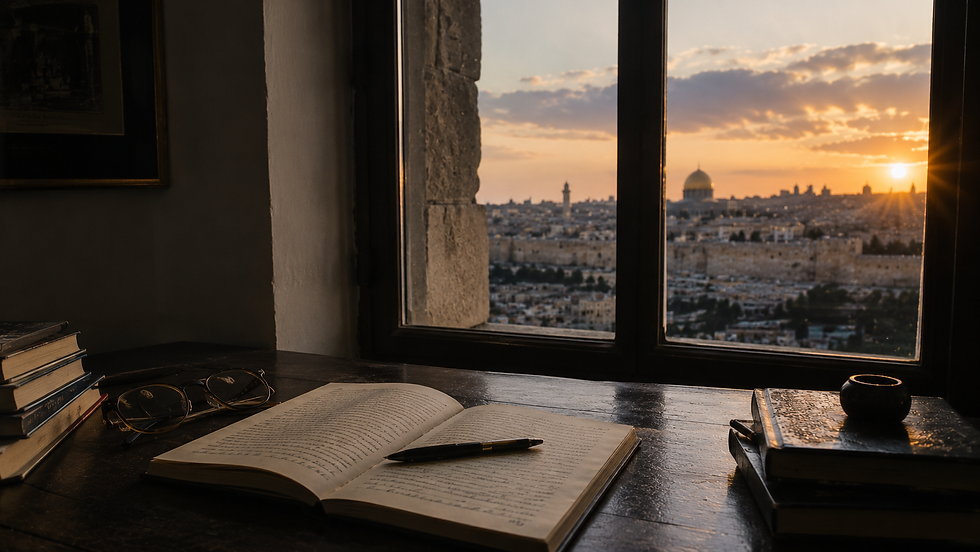
Museums are often presented as independent cultural institutions, but they commonly exist within wider systems of government ministries, universities, donors, professional organizations, tourism agencies, and national memory.
They are extensions of both the university and the state.
This does not mean a government minister personally writes every museum caption. Power is rarely so theatrical. Institutional influence is more often exercised through funding, appointments, professional norms, acquisition priorities, accepted terminology, diplomatic sensitivities, and the quiet knowledge that some interpretations will be rewarded while others will produce controversy.
Noam Chomsky's work on institutional filters is useful here, even though he was not primarily a museum theorist. Institutions need not receive direct instructions to produce limited ranges of permissible thought. The structure itself can establish which stories appear respectable and which become institutionally expensive.
Richard Rorty's work on solidarity raises another problem. Museums can expand the moral imagination by introducing visitors to unfamiliar suffering. Holocaust museums, memorials, and testimony archives have helped millions understand where antisemitism can lead.
Yet solidarity can become sentimental.
A visitor may weep for Jewish children murdered in 1942 and feel little obligation toward Jewish children threatened in the present. A political culture may proclaim "never again" in a memorial hall while treating contemporary Jewish fear as exaggeration or propaganda.
The museum produces sympathy. But does sympathy create responsibility?
That is not always clear.
Europe's Beautiful Jewish Absence
The most striking examples remain in Europe.
In Venice, the ghetto has become heritage. The confinement once imposed upon Jews is now part of the city's cultural landscape. Visitors can admire the architecture and hear the history without necessarily confronting the modern question beneath it: what happens when Jewish containment becomes picturesque?
Prague presents one of the world's most extraordinary collections of Jewish sites and objects. Its synagogues, cemetery, ritual collections, and historical exhibitions preserve an immense amount of Jewish history. Yet the scale of the heritage environment can produce a haunting inversion. Jewish absence itself becomes aesthetically magnificent.
Budapest presents a different case because Jewish life remains visible and active. Its synagogues, Holocaust memorials, political conflicts, living congregations, and competing national narratives make it impossible to reduce Hungarian Jewry entirely to a vanished world. It demonstrates why this research must distinguish between countries, cities, and institutions rather than imposing one theory upon them all.
Britain presents another contradiction. Jewish emancipation and refugee history are incorporated into a liberal national narrative, while contemporary Jewish concerns, particularly those connected to Israel and Zionism, may be treated as morally suspect in universities, cultural institutions, and public debate.
The historic Jew belongs to British history. The political Jew must still explain himself.
The Empty Synagogue of the Middle East
The same questions extend beyond Europe.
Egypt, Iraq, Libya, Syria, Lebanon, Algeria, Tunisia, Morocco, Iran, and other countries once contained Jewish communities with deep historical roots. Their synagogues, cemeteries, manuscripts, schools, and neighborhoods are not simply foreign relics. They are evidence that Jews were part of Middle Eastern and North African history long before the twentieth-century conflict over Israel.
Yet the preservation of these sites can become politically selective.
A government may restore a synagogue as proof of tolerance while avoiding a direct account of why its Jewish population disappeared. The state can celebrate a Jewish past while treating the departure, dispossession, or expulsion of Jews as an unfortunate mystery without political authors.
The synagogue becomes an exhibition of pluralism after pluralism has ended.
This does not make restoration meaningless. It makes interpretation essential.
A beautifully restored synagogue with no Jews may be a monument to tolerance. It may also be a monument to the success of intolerance. Sometimes it is both.
The Americas and the Living Museum
Central and South America offer important comparisons because the Jewish museum is not always surrounded by Jewish absence.
Argentina, Brazil, Mexico, Uruguay, Chile, Colombia, Cuba, Curaçao, and other parts of the region contain different combinations of immigration history, surviving Jewish communities, Holocaust memory, dictatorship, terrorism, religious continuity, and changing relations with Israel.
Argentina is especially important. It has one of the world's largest Jewish communities outside Israel, a rich Jewish cultural history, Holocaust institutions, immigration museums, and the unresolved trauma of the AMIA bombing. Here the Jewish museum does not simply preserve a vanished population. It exists beside a living community capable of challenging how Jewish history is narrated.
Curaçao offers another type of story: longstanding Sephardic continuity, Atlantic commerce, colonial society, and one of the oldest surviving Jewish congregations in the Americas.
These comparisons prevent the project from becoming a simple account of European guilt. They allow a broader question:
When does Jewish heritage belong to the nation, and when does the nation recognize that it still belongs to Jews?
New York and the Contemporary Jew
The book will eventually arrive in New York.
No city better demonstrates the paradox of Jewish visibility and Jewish uncertainty. New York contains one of the largest Jewish populations in the world. It has major Jewish museums, archives, universities, synagogues, cultural institutions, newspapers, charities, and memorials.
The Jew is hardly absent from New York.
Yet the public recognition of Jewish life remains divided. The immigrant Jew, labor organizer, comedian, artist, intellectual, and Holocaust survivor occupy secure places in the city's mythology. The Zionist Jew, Israeli Jew, visibly religious Jew, or Jew who regards Israel as necessary to Jewish survival may face a different reception.
The question is therefore not whether New York acknowledges Jews.
It plainly does.
The question is:
Which Jew does New York acknowledge?
This is becoming one of the central political questions of 2026. A city may celebrate Jewish culture while its leaders, universities, and institutions dispute the legitimacy of Jewish sovereignty or dismiss the fears of Jews who see Israel as a refuge rather than an abstraction.
This is not merely an argument about one mayor, one protest, or one administration. It is a struggle over whether Jewish political identity belongs inside the acceptable museum of New York's diversity.
Why This Matters Now
This research is not ultimately about museum administration. It is about the modern politics of personhood.
The Jewish experience provides an unusually revealing test. Jews have been preserved as texts, objects, ruins, victims, memories, and moral lessons. They have also been asked repeatedly to surrender the forms of collective identity that make Jewish life more than a historical exhibit.
A society can admire Jewish culture and dislike Jewish particularity.
It can condemn historical antisemitism and tolerate its modern substitutions.
It can honor Holocaust victims while treating Jewish self-defense as an embarrassment.
It can preserve the synagogue while rejecting the sovereign Jew.
That is the contradiction I want to understand.
The museum after the murder may be sincere. It may be beautiful. It may rescue irreplaceable evidence. But the question remains:
Is the museum preserving Jewish history, or is it using Jewish history to avoid the complications of the Jewish present?
My current research begins there in Venice, Egypt, Prague, Budapest, London, New York, and the many other places where the Jew remains visible in stone, glass, archive, and exhibition.
The modern museum does not always erase the Jew.
Sometimes it does something more revealing.
It preserves the Jew in the tense most convenient to the nation:
the past.
More about Dr. Matthew Weinberg's personal commitment to fighting antisemitism and supporting Jewish communal institutions is on the Philanthropy page.
Dr. Matthew Weinberg, PhD, MEd is an educator, author, co-founder of The Barrett School, Vice President of the Gloria C. MacKenzie Foundation, and founder of Grammar & Stone Publishing. His books are available at Barnes & Noble. Follow him on Instagram, TikTok, YouTube, X, LinkedIn, Medium, and Quora.



Comments