
Seventy Days in Alexandria

Updated: Jul 24

O. Von Corven - Tolzmann, Don Heinrich; Alfred Hessel and Reuben Peiss. The Memory of Mankind. New Castle, DE: Oak Ptolemy II, Seventy Translators, and the Birth of the Greek Bible
In the third century BCE, somewhere between royal banquets and the quiet scratch of reed pens on papyrus, one of the most consequential translation projects in human history began.
The setting was Alexandria, the brilliant port city of the Hellenistic world. Ships arrived from every shore of the Mediterranean. Astronomers charted the stars. Physicians studied anatomy. Philosophers argued beneath shaded colonnades. And at the heart of the royal district stood the most ambitious intellectual institution the ancient world had ever seen: the Library of Alexandria. The Ptolemies intended it to hold every book on earth.
Among the texts the library lacked was the sacred law of the Jews—the Torah. The problem was not its absence from the world, but its language: Hebrew. The scholarly language of the Mediterranean was Greek. Translation, therefore, became inevitable. What followed would become legend.
Alexandria and the Imperial Dream of Knowledge
After the death of Alexander the Great in 323 BCE, his empire fractured into several Hellenistic kingdoms. Egypt came under the control of Ptolemy I Soter, who founded a dynasty that would rule until Rome absorbed Egypt in 30 BCE. His son Ptolemy II Philadelphus (285–246 BCE) expanded his father’s vision: Alexandria would become the intellectual capital of the Mediterranean world.
The Mouseion, attached to the library, functioned like a research institute where scholars lived and worked under royal patronage. Poets, mathematicians, philologists, and historians gathered there to study texts from across the known world.
Ancient sources describe extraordinary acquisition policies. According to Galen, scrolls found on ships entering Alexandria were seized, copied, and cataloged. Sometimes the originals were kept in the royal collection. The ambition was breathtaking: to assemble the written knowledge of civilization.
Yet that project required translation. Greek scholars could not read texts written in Hebrew, Egyptian, or Aramaic. Thus translation became a royal endeavor.
The Letter of Aristeas

Beginning of the Letter of Aristeas. Biblioteca Apostolica Vaticana, Vat. gr. 747, f. 1r
Our principal narrative comes from the Letter of Aristeas, likely written in the late third or early second century BCE by a Hellenistic Jew writing in elegant Greek. The author introduces his account with the formal greeting:
Ἀριστέας Φιλοκράτει τῷ ἀδελφῷ χαίρειν.
Aristeas to his brother Philocrates, greetings.
The letter describes how Demetrius of Phalerum, the king’s librarian, informed Ptolemy that the library lacked one of the most famous legal codes of the ancient world.
οἱ τῶν Ἰουδαίων νόμοι ἄξιοι τῆς βασιλικῆς βιβλιοθήκης.
The laws of the Jews are worthy of the royal library.
(Letter of Aristeas, paraphrasing §§30–31)
Ptolemy agreed. But before requesting the translation, the king performed an act of diplomacy.
The Liberation of Jewish Captives
The Letter of Aristeas claims that Ptolemy II freed approximately 70,000 Jewish slaves in Egypt before inviting the translators. The decree is described in the text:
ἀπέλυσεν ὁ βασιλεὺς τοὺς ἐκ τοῦ ἔθνους τῶν Ἰουδαίων αἰχμαλώτους.
The king released those of the Jewish nation who had been taken captive.
The number is probably symbolic or exaggerated. Yet Jewish communities were indeed well established in Egypt during the Hellenistic period, particularly in Alexandria. The liberation story serves a narrative function: portraying the translation as a gesture of royal respect toward Jewish law and learning.
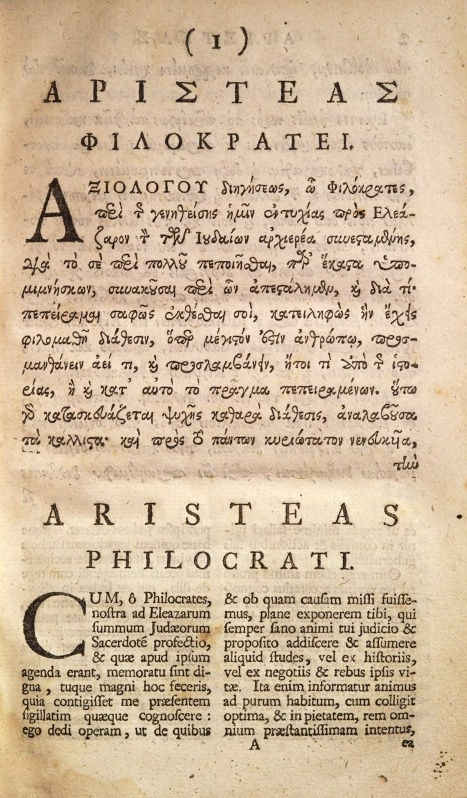
Letter of Aristeas, 1692 bilingual Oxford edition
Ptolemy sent envoys to Jerusalem requesting scholars capable of translating the Torah. The high priest Eleazar selected six elders from each of the twelve tribes, producing seventy-two translators.. The letter praises them as:
ἄνδρες σεμνοί καὶ σοφοὶ περὶ τοὺς νόμους.
Men dignified and wise in matters of the law
They traveled to Alexandria carrying sacred scrolls. Their arrival symbolized an extraordinary meeting of worlds: the priestly scholarship of Jerusalem and the cosmopolitan intellectual culture of Alexandria.
Banquets of Philosophy

A detail of the Nile mosaic of Palestrina, showing Ptolemaic Egypt c. 100 BC.
Before the translation began, Ptolemy hosted a series of royal banquets. At each banquet he asked the scholars questions about ethics, kingship, and wisdom. The translators responded with concise reflections blending Jewish wisdom with Greek philosophical language. One response summarized the tone of the dialogue:
ὁ φόβος τοῦ θεοῦ ἀρχὴ σοφίας.
The fear of God is the beginning of wisdom.
Scholars widely believe these dialogues were literary constructions intended to present Judaism as philosophically respectable within the Hellenistic world.
Seventy Days on the Island of Pharos
After the banquets concluded, the translators were taken to a quiet place—traditionally associated with the island of Pharos, near Alexandria’s lighthouse. There they worked in seclusion. According to the narrative, the translation of the Torah into Greek took seventy days.
The result became known as the Septuagint (from the Latin septuaginta, meaning “seventy”). But later traditions embellished the story dramatically.
Several ancient traditions claimed that the translators produced identical translations independently. One version states they worked in thirty-six pairs, each pair translating separately yet producing the same text. Another tradition preserved in the Babylonian Talmud (Megillah 9a) claims the scholars were placed in seventy separate rooms, each translating independently. When their work was compared, the texts were identical. This miraculous agreement demonstrated divine approval for the translation.
Jewish tradition also preserves a humorous observation. The miracle, it is said, is not that seventy rabbis working separately produced the same translation. The real miracle would be seventy rabbis in the same room agreeing on anything at all. Rabbinic culture thrives on debate. Interpretive disagreement is not a flaw but a method. Two rabbis often produce three opinions. The Septuagint legend turns consensus into the miracle.
Comparing the Septuagint and the Hebrew Bible
One of the most fascinating aspects of the Septuagint is that it occasionally differs from the traditional Hebrew text preserved in the Masoretic tradition. These differences can reveal how ancient translators interpreted scripture—or sometimes preserve older textual traditions.
Below are several illustrative examples.
Example 1: Isaiah 7:14
Hebrew (Masoretic Text):
הִנֵּה הָעַלְמָה הָרָה
Behold, the young woman shall conceive.
The key Hebrew word ʿalmah generally means “young woman.”
Septuagint Greek:
ἰδοὺ ἡ παρθένος ἐν γαστρὶ λήμψεται
Behold, the virgin shall conceive.
The Greek word παρθένος (parthenos) means “virgin.” This translation later became extremely influential in Christian interpretation of the verse.
Example 2: Psalm 22:16
Hebrew
כָּאֲרִי יָדַי וְרַגְלָי
Like a lion [they are at] my hands and feet.
The Hebrew text is difficult and ambiguous.
Septuagint
ὤρυξαν χεῖράς μου καὶ πόδας
They pierced my hands and feet.
The Septuagint preserves a different interpretive tradition that later influenced Christian readings of the psalm.
Example 3: Genesis 4:8
Hebrew (Masoretic)
Cain spoke to Abel his brother…
(The sentence ends abruptly.)
Septuagint
Καὶ εἶπεν Κάϊν τῷ Ἄβελ… Διέλθωμεν εἰς τὸ πεδίον.
Cain said to Abel his brother, “Let us go out into the field.”
The Greek text preserves a fuller narrative that later manuscripts of the Hebrew Bible lack.
What the Differences Mean
These variations demonstrate something important: the Septuagint translators were not simply copying a fixed Hebrew text. The discovery of the Dead Sea Scrolls confirmed that multiple textual traditions of the Hebrew Bible existed during the Second Temple period. In some cases the Septuagint preserves readings closer to these older Hebrew traditions. Translation therefore became an unexpected form of textual preservation.
The King Behind the Story

The patron of this translation project, Ptolemy II Philadelphus, ruled during the golden age of Alexandrian scholarship. His epithet “Philadelphus” (“brother-loving”) referred to his marriage to his sister Arsinoë II, following Egyptian royal tradition. The Ptolemaic court blended Greek and Egyptian cultural practices, creating one of the most cosmopolitan environments in the ancient world. In such a setting, translating the Torah into Greek was perfectly aligned with the dynasty’s cultural ambitions.
Bust of Ptolemy II, National Archaeological Museum, Naples
Translation as Civilization
The Letter of Aristeas is not pure history. Its speeches are stylized. Its numbers are symbolic. Its narrative serves theological and cultural purposes. Yet beneath the legend lies a real historical achievement: the creation of the Greek Bible of the Jewish diaspora.
Selected Scholarly Bibliography
Bickerman, Elias. The Jews in the Greek Age. Harvard University Press, 1988.
Collins, John J. Between Athens and Jerusalem: Jewish Identity in the Hellenistic Diaspora. Eerdmans, 2000.
Hengel, Martin. Judaism and Hellenism. Fortress Press, 1974.
Honigman, Sylvie. The Septuagint and Homeric Scholarship in Alexandria. Routledge, 2003.
Jobes, Karen H., and Moisés Silva. Invitation to the Septuagint. Baker Academic, 2015.
Rajak, Tessa. Translation and Survival: The Greek Bible of the Ancient Jewish Diaspora. Oxford University Press, 2009.
Schürer, Emil. The History of the Jewish People in the Age of Jesus Christ. T&T Clark, 1973.
Wasserstein, Abraham & David Wasserstein. The Legend of the Septuagint. Cambridge University Press, 2006.
Wright, Benjamin G. The Letter of Aristeas: A New Translation and Commentary. De Gruyter, 2015.
Primary Sources
Letter of Aristeas
Josephus, Antiquities of the Jews 12.11–118
Philo of Alexandria, Life of Moses II.25–44
Babylonian Talmud, Megillah 9a


Comments