
Knowing Biology Did Not Make Me a Biology Teacher


The Dangerous Myth Behind Homeschooling and the Deprofessionalization of Education
When I completed medical school and entered oncology, I believed I understood biology well enough to teach it. The belief seemed entirely reasonable. I had studied anatomy, physiology, pathology, genetics, microbiology, biochemistry, pharmacology, immunology, and the cellular mechanisms of disease. Oncology required an intimate understanding of what happens when the ordinary systems governing cellular growth, repair, differentiation, and death become malignant. Outside the increasingly specialized details examined by researchers working at the highest levels of molecular biology, I knew far more biological content than any middle- or high-school curriculum could possibly require.
Surely, I thought, teaching biology would simply mean explaining what I already knew.
I was wrong, not slightly wrong, but fundamentally wrong.
What I possessed was extensive content knowledge. What I did not yet possess was the professional knowledge required to transform that content into learning. I knew how cells worked, but I did not automatically know how a fourteen-year-old imagined that they worked. I did not yet know which misconceptions students were likely to bring into the classroom, which analogy would clarify a difficult process, which analogy would create an entirely new misunderstanding, when to introduce technical vocabulary, when to delay it, when to use a diagram, when to use a physical model, when to explain directly, when to ask questions, or how to determine whether a student had understood rather than merely repeated my words.
It took years of educational study, professional practice, graduate work in multicultural education, and doctoral-level work in education to understand the depth of my original mistake. I had confused knowing a discipline with knowing how to teach it.
That same confusion now shapes much of the American debate over education. It lies beneath the rapid expansion of homeschooling, unschooling, learning pods, automated instructional platforms, packaged curricula, and taxpayer-funded parent-directed education. The premise is rarely stated openly, but it is unmistakable: teaching is not a specialized profession. It is merely the possession and delivery of information.
Anyone who has seriously taught children knows how ludicrous that premise is.
Teaching Is Not Content Delivery

Content knowledge is necessary. A person cannot responsibly teach material that the person does not understand. Yet content knowledge alone no more produces a teacher than knowledge of anatomy produces a surgeon.
A surgeon must know anatomy, but surgery is a practice. It involves recognizing structures under imperfect conditions, selecting techniques, interpreting unexpected findings, responding to complications, coordinating a team, and adjusting when the living body does not resemble the clean illustration in a textbook. Teaching is similarly practical, diagnostic, relational, and adaptive.
A biology teacher does not simply know cellular respiration. The teacher must determine how to represent cellular respiration to a particular group of students at a particular stage of development. Should instruction begin with food, energy, chemical bonds, mitochondria, respiration, photosynthesis, or the relationship among them? Which concepts must already be secure? Which vocabulary is essential now, and which terminology would overload working memory? Would students benefit most from explicit instruction, a visual model, a laboratory investigation, a simulation, guided practice, peer explanation, retrieval exercises, or a deliberately sequenced combination of methods?
The professionally important question is not merely, “Do I understand this?”
It is, “What must happen for these students to understand it?”
Lee Shulman described part of this expertise as pedagogical content knowledge: the specialized ability to transform subject matter into representations learners can understand, anticipate misconceptions, interpret student thinking, and choose methods appropriate to particular ideas and learners (Shulman, 1986, 1987). Subsequent scholarship has confirmed that effective teachers possess forms of professional knowledge that are neither ordinary subject expertise nor generic interpersonal talent (Ball et al., 2008; Grossman, 1990; Hill et al., 2005; Kunter et al., 2013).
A mathematician may understand advanced mathematics while remaining unable to explain why a child repeatedly reverses the numerator and denominator. A novelist may write beautifully while having no idea how to teach a struggling student to organize a paragraph. A physician may understand neuroanatomy yet lack the training to distinguish a knowledge gap from dyslexia, language impairment, anxiety, attention difficulty, processing-speed weakness, or excessive cognitive load.
These are not necessarily failures of intelligence. They are failures of professional preparation.
Teaching is not what happens automatically after someone learns a subject. It is an independent intellectual and practical discipline.
Methodology Is More Important Than the Performance of Knowing

The popular image of teaching is a knowledgeable adult speaking while children listen. Much of a teacher’s most sophisticated work, however, occurs before, around, and after the explanation.
A teacher must first determine what students already know. New knowledge is interpreted through prior knowledge, including incomplete knowledge, cultural assumptions, intuitive theories, and misconceptions. Students do not receive information like empty containers being filled. They reconstruct what they hear, sometimes accurately and sometimes disastrously.
A student may memorize that plants “make food from sunlight” while imagining that sunlight is a physical substance absorbed through leaves. Another may recite the stages of mitosis without understanding why cells divide or what occurs when cell-cycle regulation fails. A student may correctly state that heavier objects fall at the same rate in a vacuum while privately retaining the intuitive belief that weight itself causes faster falling.
The teacher must uncover the learner’s internal model before helping the learner revise it.
This is why formative assessment is central to professional instruction. Its purpose is not merely to assign a grade. It is to make student thinking visible so that instruction can be adjusted (Black & Wiliam, 1998; Wiliam, 2011). A skilled teacher listens to explanations, studies errors, compares patterns across students, watches for hesitation, and decides what should happen next.
That decision is methodological.
Should the teacher provide more explicit guidance? Reduce the number of interacting elements? Return to prerequisite knowledge? Model a worked example? Ask the student to explain each step? Introduce contrasting cases? Use manipulatives? Pair students for carefully structured discussion? Delay an abstraction? Alter the sequence entirely?
Research on cognitive load shows that poorly designed instruction can overwhelm working memory even when every statement made by the instructor is factually accurate (Sweller, 1988; Sweller et al., 2019). Research on retrieval practice shows that durable memory is strengthened when learners must actively recall information rather than merely reread or rewatch it (Roediger & Butler, 2011; Roediger & Karpicke, 2006). Research on spacing demonstrates that learning improves when practice is distributed across time rather than compressed into a single session (Cepeda et al., 2006). Studies of self-explanation, worked examples, feedback, metacognition, and guided practice similarly demonstrate that instructional choices substantially influence whether information becomes usable knowledge (Chi et al., 1989; Dunlosky et al., 2013; Hattie & Timperley, 2007; Kirschner et al., 2006).
None of those decisions is contained inside the content itself.
A textbook can accurately describe the law of conservation of mass. It cannot observe a particular child’s misconception, notice confusion, compare today’s answer with last week’s work, or determine that the student has memorized an equation without understanding the physical principle. A video can explain an idea. It cannot reliably diagnose why a learner misunderstood it.
A curriculum is a tool. It is not a teacher.
Technology can support instruction. It cannot replace the relational and diagnostic judgment of a competent educator. Artificial intelligence may generate explanations, quizzes, simulations, and immediate feedback, but those functions remain educationally meaningful only when someone understands the learner, selects appropriate goals, evaluates the quality of the response, recognizes misconceptions, and determines what should happen next.
The defining expertise of the teacher is therefore not the ability to perform knowledge in front of children. It is the ability to design, observe, diagnose, adapt, and cause learning.
Expertise Becomes Most Visible When the Lesson Fails
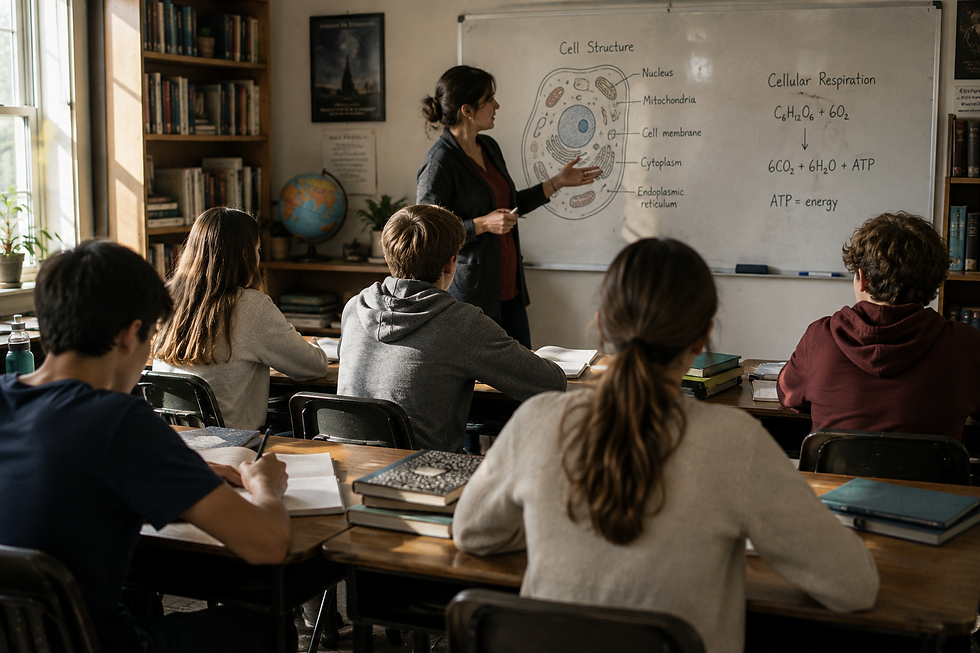
Amateurs often judge teaching by how smoothly a lesson is presented. Professionals understand that the deeper test comes when the lesson does not work.
Two students can hear the same explanation and produce entirely different understandings. The amateur assumes that the confused student was inattentive, unmotivated, or simply needs to hear the same words again. The teacher begins a diagnostic process.
Does the student lack prerequisite knowledge? Is the vocabulary inaccessible? Is the representation too abstract? Does the student have difficulty holding several elements in working memory? Has an earlier misconception become embedded? Is the task linguistically or culturally unfamiliar? Is anxiety interfering with retrieval? Does the student understand orally but struggle to express the idea in writing? Is there evidence of a learning disability that requires evaluation?
The professional response is not simply to “teach harder.” It is to change the conditions under which learning is expected to occur.
Experienced teachers develop patterns of professional perception. They notice features of student behavior and classroom interaction that novices frequently miss. They organize problems differently, anticipate likely errors, distinguish superficial compliance from genuine understanding, and draw upon a repertoire of methods rather than one preferred technique (Berliner, 2001; Carter et al., 1988; Sabers et al., 1991).
Professional teaching is not the possession of a magical personality. It is the result of study, supervised practice, reflection, observation, comparison, and correction.
My medical education initially gave me none of that. It allowed me to evaluate the scientific accuracy of biological content. It did not tell me how children constructed biological concepts, how memory worked in a classroom, how culture influenced participation, how disability affected access, or how to design instruction for a group of learners with different histories and needs.
I had to learn education.
Multicultural Education Is Not a Decorative Addition
My graduate work in multicultural education also changed how I understood teaching. Before sustained educational study, it is easy to imagine that culture is something added to a curriculum: a different author, a holiday, a flag, a recipe, or a picture placed on a classroom wall.
Culture is not decoration. It influences language, communication, authority, participation, expectations, interpretation, identity, and belonging. Students do not enter classrooms as disembodied brains. They arrive with family histories, linguistic patterns, religious traditions, cultural memories, experiences of disability or exclusion, ideas about authority, and differing relationships to institutions.
Teachers must ask whose knowledge is treated as normal, which references students are expected to understand, whether a classroom rewards only one type of participation, and whether unconscious bias affects the interpretation of behavior or ability. They must distinguish equality from sameness. Giving every child precisely the same instruction can be deeply inequitable when learners possess different linguistic, developmental, physical, or educational needs.
Culturally responsive teaching does not require abandoning academic standards. Properly understood, it is the professional work of making rigorous knowledge accessible while maintaining its intellectual seriousness (Gay, 2018; Ladson-Billings, 1995).
Parents naturally know important things about their children. They understand family history, temperament, interests, routines, fears, and experiences unavailable to a classroom teacher. That knowledge is essential, but it is not interchangeable with professional educational knowledge.
Knowing one child intimately is not the same as developing a comparative understanding of hundreds of learners, developmental trajectories, interventions, assessment patterns, cultural differences, disabilities, curricula, and instructional methods.
Parental knowledge and teacher knowledge should cooperate. One should not be mistaken for the other.
The Homeschooling Movement Depends Upon the Content Myth

The expansion of homeschooling has been aided by the belief that education is principally a collection of information to be covered. Once education is reduced to content, homeschooling appears easy to reproduce.
Purchase a mathematics program. Subscribe to a science platform. Download history worksheets. Assign novels. Watch lectures. Mark the answers. Record the completed hours. Submit the required paperwork.
But acquiring instructional products is not the same as providing professional instruction.
A family can purchase an excellent curriculum and implement it poorly. A parent can select a deeply flawed curriculum and lack the professional knowledge needed to recognize its defects. A child can complete every page while retaining little. Assignments can be finished through copying, guessing, searching online, or manipulating automated platforms. Without independent assessment, the appearance of education may continue for years before serious deficiencies become visible.
Homeschool advocates correctly observe that some parents provide excellent instruction. That is true, but it does not answer the public-policy question. Some unlicensed individuals would probably prove competent at nursing, accounting, electrical work, or structural design. Society does not establish professional standards around unusually capable exceptions.
The existence of successful homeschooling families does not prove that parent-directed education is generally equivalent to instruction provided by trained, specialized, and independently accountable professionals. It certainly does not justify transferring public money to families on the assumption that educational competence exists merely because a parent claims it.
Reviews of homeschooling research repeatedly identify major limitations in the evidence: self-selected samples, voluntary testing, small or unrepresentative groups, inconsistent definitions, weak comparison populations, incomplete demographic controls, and a shortage of representative longitudinal data (Kunzman & Gaither, 2013, 2020; Lubienski et al., 2013; Murphy, 2014). Researchers have also warned that favorable samples of highly motivated families cannot be generalized to children whose parents provide inadequate instruction, decline assessments, or remain largely invisible to educational authorities.
The children most likely to be harmed by homeschooling are also the least likely to appear in studies celebrating its success.
Homeschooling Can Conceal Educational Neglect
In a functioning school, a child is seen by multiple adults. Teachers compare observations. A science teacher may notice a reading problem. An art teacher may observe a sudden change in mood. A counselor may identify anxiety. A speech-language pathologist may recognize a communication disorder. A special-education team may detect a pattern across subjects and settings.
No school is infallible, but multiple observers create multiple opportunities for difficulty to be recognized.
In homeschooling, the same parent may select the curriculum, provide instruction, determine the schedule, evaluate the child’s work, interpret the results, report progress, and decide whether outside intervention is necessary. In nearly any other publicly funded service, that concentration of authority would be recognized as a conflict of interest.
It is educational self-certification.
The risks are especially serious for children with dyslexia, dyscalculia, autism, attention disorders, language impairments, emotional disabilities, or intellectual differences. These conditions do not disappear because an adult rejects labels or insists that a child will develop “when ready.” Early identification and evidence-based intervention can improve outcomes, while delayed assistance allows academic difficulties and emotional distress to accumulate (Fletcher et al., 2019; Fuchs & Fuchs, 2006; Snowling & Hulme, 2012; Torgesen, 2004).
Unschooling magnifies this problem by interpreting avoidance as autonomy. A child avoiding reading may be exercising freedom or concealing dyslexia. A child refusing mathematics may be pursuing an individual path or protecting himself from the humiliation of years of unresolved confusion. A child spending every day on a preferred activity may be following a passion or demonstrating an executive-function difficulty that requires structure and intervention.
Without professional evaluation, ideology can replace diagnosis.
Neglect does not become educational philosophy merely because adults call it child-led learning.
Socialization Is Not an Extracurricular Appointment
Homeschool advocates frequently answer concerns about socialization by listing activities: sports, church, music lessons, cooperative classes, library groups, field trips, neighborhood play, or community events.
These activities can be valuable. They are not necessarily equivalent to sustained membership in a diverse educational community.
Children do not develop socially simply by being placed near other children for scheduled periods. They develop through recurring relationships, shared obligations, disagreement, negotiation, cooperation, embarrassment, competition, friendship, conflict, reconciliation, and changing group roles.
Peer relationships influence motivation, belonging, emotional regulation, identity formation, academic engagement, and later adjustment (Gifford-Smith & Brownell, 2003; Parker & Asher, 1987; Wentzel, 1998). Properly structured cooperative learning can improve both academic achievement and peer relationships (Johnson & Johnson, 2009; Roseth et al., 2008). A substantial research literature also connects school belonging with academic, behavioral, and psychological outcomes (Allen et al., 2018; Wang & Degol, 2016).
A weekly activity selected and supervised by parents does not necessarily reproduce a community in which students must coexist with people they did not choose.
That distinction matters. A child may attend numerous activities and still remain inside a carefully curated cultural world. The issue is not simply the number of social contacts but their range, independence, continuity, and depth.
Education Must Introduce Children to the Wider Human World
Children need sustained relationships with people who do not look like their families, speak like their families, worship like their families, vote like their families, learn like their families, or organize their lives according to the same cultural assumptions.
Encountering difference is not a decorative enrichment added after academic instruction. It is part of becoming an educated human being and an American citizen.
The United States has never been held together by complete cultural sameness. It is an ongoing experiment in whether people of different races, religions, ethnicities, languages, abilities, classes, regions, political traditions, and family histories can inhabit common institutions without demanding that everyone become identical. That experiment depends upon citizens learning how to live alongside people they did not personally select.
Schools are among the first places where this difficult civic education occurs.
A child enters a classroom and discovers that another family eats different foods, observes different holidays, speaks another language at home, or remembers history differently. Students encounter classmates with disabilities, unfamiliar religious beliefs, different economic circumstances, and personalities unlike those found in their households. They must work with peers they might never independently choose as friends. They must listen to adults whose accents, histories, cultures, and experiences differ from those of their parents.
Through these encounters, children gradually learn that unfamiliarity is not danger and disagreement does not automatically make another person an enemy.
That is part of the American experiment.
A genuinely multicultural education is not a procession of heritage months, flags, recipes, or famous historical figures. It is the daily practice of living among human difference. It asks students to interpret unfamiliar behavior with curiosity rather than suspicion, examine their assumptions, and recognize that their family’s habits are not the only natural or legitimate way to exist.
Research on intergroup contact has repeatedly found that meaningful interaction across group boundaries can reduce prejudice, especially when participants cooperate under conditions of relative equality, shared goals, institutional support, and genuine interpersonal engagement (Allport, 1954; Pettigrew & Tropp, 2006, 2008). Diverse educational settings can also encourage perspective-taking, cognitive complexity, civic engagement, and preparation for participation in a pluralistic society (Gurin et al., 2002; Mickelson & Nkomo, 2012; Wells et al., 2016).
This does not mean that placing diverse children in the same building automatically creates tolerance. Schools can reproduce prejudice, segregation, inequality, and exclusion. Diversity must be accompanied by skilled teaching, thoughtful leadership, equitable practices, and meaningful cooperation.
The imperfection of shared institutions does not eliminate their civic importance.
It shows why professional education is required.
The Homeschool Silo
Homeschooling gives parents extraordinary power to determine not only what a child learns but whom the child is permitted to know.
A parent can choose the curriculum, the cooperative, the instructors, the church, the activities, the families, and the range of permissible cultural or political exposure. When an encounter becomes uncomfortable, the family can withdraw. When an idea challenges the household worldview, the source can be removed.
This does not mean every homeschooling family deliberately isolates its children. Some parents make serious efforts to create broad social and intellectual experiences. The structural problem is that exposure to difference becomes almost entirely dependent upon parental preference.
A parent who values pluralism may create a broad social world. A parent who fears difference can construct an extraordinarily narrow one, while the child has little power to seek alternatives.
The educational environment can consequently become a cultural echo chamber in which the family selects the questions, supplies the answers, chooses the authorities, controls competing interpretations, and determines who counts as a trustworthy person. A child may become highly articulate within a single moral, political, or religious vocabulary while remaining unable to communicate beyond it.
This silo effect should concern anyone thinking seriously about the future of the country.
Democratic citizenship requires more than private virtue and academic competence. It requires the ability to interpret people whose experiences differ from one’s own, tolerate ambiguity, evaluate competing claims, and cooperate across cultural and ideological boundaries. Research on civic education has found that open classroom climates, discussion of contested issues, and opportunities for participation can support political knowledge and civic engagement (Campbell, 2008; Flanagan & Levine, 2010; Hess & McAvoy, 2015; Torney-Purta, 2002).
A nation cannot remain a nation if its citizens occupy entirely separate realities.
The danger becomes more serious when homeschooling is chosen specifically to prevent children from encountering identities, beliefs, histories, or communities their parents dislike. Withdrawal then becomes more than an educational preference. It becomes a mechanism of ideological insulation.
Public money may consequently subsidize the construction of private cultural silos while the common institutions necessary for democratic life continue to weaken.
The state should not finance that fragmentation.
The Classmate Complicates the Stereotype
Prejudice grows easily through abstraction and distance. It is simple to fear “immigrants,” “Muslims,” “Jews,” “Christians,” “Black people,” “gay people,” “disabled people,” “liberals,” or “conservatives” when these groups exist only as categories described by trusted adults, online influencers, or partisan media.
It becomes harder to sustain a crude generalization after sharing a laboratory table, rehearsing a play, losing a basketball game, working through a difficult project, or forming a friendship with an actual human being.
The classmate complicates the stereotype.
The student wearing unfamiliar religious clothing is no longer merely a representative of a group. She is funny, shy, irritating, brilliant, generous, competitive, or terrible at kickball. Difference becomes attached to a complete person rather than an abstract political category.
Schools generate thousands of these ordinary complications. They are among the quiet mechanisms through which pluralistic societies reproduce themselves.
Homeschooling cannot reliably reproduce this experience because its social environment is ordinarily curated by the family. Even a crowded schedule can remain culturally homogeneous. A child can be surrounded by people and still inhabit a silo.
Children also need adults outside their families who embody different forms of knowledge, authority, character, and experience. They need teachers with unfamiliar accents, professional backgrounds, cultural histories, intellectual interests, and religious traditions. They need to learn that trustworthy adults do not all resemble their parents and that authority can be evaluated through competence, fairness, evidence, and conduct rather than familiarity alone.
A culturally and intellectually diverse school does not require children to abandon their identities. Ideally, it helps them understand those identities more clearly by placing them in conversation with other people.
An identity that has never encountered difference may have been inherited, but it has not yet been examined.
Socratic Education Requires Difference
The importance of diverse educational communities also reaches back to the Socratic tradition. Socratic education does not merely provide approved answers. It places assumptions under pressure. It asks students what they believe, why they believe it, whether their reasoning is consistent, what evidence might change their minds, and how another person might challenge them.
That process cannot reach its fullest form when every participant has been selected for ideological agreement.
Dialogue requires difference.
The philosophical roots of education long predate the modern classroom. Ancient Egyptian scribal traditions involved structured practice, correction, memorization, apprenticeship, and moral formation. Socrates made disciplined questioning central to intellectual development. Plato connected education to justice, civic order, truth, and the formation of character. Aristotle examined habituation, practical wisdom, virtue, and human flourishing.
Later Jewish, Christian, and Islamic traditions treated teaching as a moral and communal responsibility. Modern thinkers from Comenius, Pestalozzi, Montessori, Dewey, Vygotsky, Piaget, Bruner, and Freire continued debating how knowledge, character, freedom, authority, and community should be cultivated.
The thinkers disagreed profoundly, but they agreed that education was a serious philosophical practice.
Unschooling frequently presents the absence of formal structure as though it were philosophically neutral. It is not. Refusing to adopt a coherent curriculum is itself a curricular decision. Allowing immediate interest to govern instruction is a theory of human development. Rejecting assessment is a theory about whether adults have an obligation to determine what children know.
There is no education without philosophy. There is only examined philosophy and unexamined philosophy.
Children Need Adults Outside Their Families
Adolescents must gradually develop identities that are not completely controlled by their parents. This does not require rejecting family values. It means acquiring enough intellectual and psychological independence to examine beliefs, form judgments, build relationships, and eventually live as autonomous adults.
Teachers, counselors, coaches, and other school professionals can become important nonparental adults. They may offer expertise, encouragement, correction, or a perspective unavailable within the family. They may recognize an ability that parents overlooked or a problem that a household has normalized.
They also make children visible.
Teachers and school professionals form part of the child-protection system. They may notice hunger, bruising, untreated illness, exhaustion, fearfulness, developmental regression, sudden withdrawal, sexualized behavior, or an unexplained decline in functioning. Schools do not detect every case of abuse, and abuse can occur within institutions. Nevertheless, regular access to independent adults creates opportunities for children to be seen and heard.
Homeschooling is not evidence of abuse. Most homeschooling parents are not abusive, and it would be irresponsible to treat them as though they were. The policy problem is that removing a child from school can also remove the child from one of the few institutions through which severe neglect or maltreatment might become visible.
Recent scholarship emphasizes both the lack of comprehensive population data and the need to consider how limited contact with independent adults can affect child-safety assessment and reporting (Berrick et al., 2025). Broader legal scholarship has similarly argued that homeschooling policy often gives insufficient weight to children’s independent interests in education, protection, and eventual autonomy (Bartholet, 2020).
Children are not the private property of adults.
The Political Attack on Expertise
The growth of homeschooling cannot be entirely separated from a broader political campaign against professional expertise. In important parts of the modern conservative movement, teachers have been recast as ideological intruders, curriculum as indoctrination, libraries as dangers, and universities as enemies of ordinary families.
Institutions deserve scrutiny. Teachers can be wrong. Schools can fail students. Curricula can reflect bias. Administrators can protect ineffective practices. No profession should be placed beyond criticism.
But criticism of experts is different from the conclusion that expertise does not exist.
The rejection of educational expertise contains a striking contradiction. Conservatism has historically emphasized inherited wisdom, disciplined study, cultural continuity, institutional knowledge, and the intergenerational transmission of civilization. Yet educational populism increasingly asks individual households to reconstruct literacy, mathematics, science, history, art, music, citizenship, social development, and disability services independently.
This is not the preservation of civilization. It is the privatization of civilization into millions of disconnected households.
Civilization exists precisely because each family does not have to invent civilization again.
Florida Is Subsidizing Withdrawal From the Educational Community
Florida has moved beyond merely permitting home education. State law defines a Personalized Education Program as sequentially progressive instruction directed by a parent while the student is registered with an eligible scholarship-funding organization (Florida Legislature, 2025). The program allows students who are not enrolled full-time in public or private school to receive an education savings account for parent-directed educational expenses (Step Up For Students, 2026).
Florida’s current program materials describe eligible uses that include curricula, instructional materials, internet resources, tutoring, assessments, online providers, enrichment activities, selected camps, postsecondary instruction, and other approved expenses (Step Up For Students, 2026).
This is no longer merely a matter of parental freedom. It is a public subsidy.
A private right to make a choice does not automatically establish a public obligation to finance that choice. Parents may retain broad authority to educate children at home, but taxpayers have every right to ask what public purpose is served by paying households to leave common educational institutions and direct their own children’s instruction.
Public funding should purchase publicly defensible educational outcomes.
An education savings account risks converting schooling into a household reimbursement system. A family purchases a curriculum, device, lesson, service, camp, or approved material. A receipt proves that money was spent. It does not establish that learning occurred.
An invoice is not an assessment.
Florida’s program does contain assessment and learning-plan requirements, and it should be described accurately rather than caricatured. Yet the larger structural problem remains: the parent directs the education, chooses many of the services, controls much of the learning environment, and receives public resources for a program taking place substantially outside the daily supervision of a school.
The public is entitled to ask whether the level of oversight is proportionate to the educational and financial responsibility being transferred.
Public Money Creates Public Obligations
The state does not have an obligation to subsidize every adult’s preferred educational ideology.
Florida should not provide general taxpayer-supported funding for ordinary parent-directed homeschooling. Public educational funds should principally support accountable schools, qualified educators, disability services, libraries, laboratories, arts programs, counseling, transportation, athletics, and other infrastructure serving communities of children.
Limited exceptions may be defensible for students whose documented medical or disability needs cannot be met in an available school. Even then, public funding should require independent evaluation, qualified providers, transparent expenditures, measurable goals, and regular evidence of progress.
Every publicly funded home-based program should, at minimum, require independent academic assessment, a documented curriculum across the major disciplines, access to qualified subject teachers, disability screening and referral procedures, regular private contact between the child and an independent professional, evidence of sustained peer participation, financial auditing, and transparent reporting of academic and long-term outcomes.
Without such protections, the state is not funding demonstrated education. It is funding parental assertion.
Financial Incentives Matter
It is uncomfortable but necessary to acknowledge that public subsidies alter parental incentives.
Not every family using a scholarship is motivated by money. Many parents undoubtedly believe they are acting in their children’s best interests. That truth does not eliminate the financial incentive created when a household can receive thousands of dollars in education-related purchasing power after declining full-time enrollment in public or private school.
Public policy should not encourage families to view withdrawal from school as an opportunity to capture funds for household-directed spending.
The concern is not merely fraud in the narrow legal sense. A purchase can satisfy program rules while still contributing little to a coherent education. Families may acquire devices, subscriptions, lessons, materials, and activities that appear educational individually but do not combine into a serious curriculum or produce measurable learning.
The marketplace rewards what can be marketed and reimbursed. It does not automatically reward what is instructionally effective.
Parents also face substantial information problems. Educational quality is difficult to judge immediately. Children may enjoy a program while learning little.
Deficiencies may remain hidden until years later. Providers can sell novelty more easily than durable understanding. The adult purchasing the product is not the child who must live with its long-term consequences.
Education is not an ordinary consumer market.
Subsidized Exit Can Weaken Common Institutions
It would overstate the available evidence to claim that homeschooling alone caused the decline of American education. Schools face many pressures, including chronic absenteeism, teacher shortages, political interference, unequal funding, administrative burdens, post-pandemic learning loss, demographic change, and declining institutional trust.
Nevertheless, subsidized exit can contribute to educational fragmentation and institutional erosion.
Schools operate through shared systems. They maintain facilities, laboratories, libraries, transportation networks, arts programs, athletics, counseling services, special-education teams, and specialized staff. Many of these costs do not decline proportionally each time an individual student leaves.
A school cannot reduce one-thirtieth of a teacher, one-fiftieth of a laboratory, or one-hundredth of a bus route every time enrollment changes. Losses can eventually force reductions in courses, staffing, activities, or services, affecting the children who remain.
Research on public-school finance has found that sustained educational spending can improve academic attainment and long-term economic outcomes, particularly for disadvantaged students (Jackson et al., 2016).
A full account of Dr. Matthew Weinberg’s background as an educator, physician, and researcher is available here. His research on game theory in education examines how incentive structures shape learning outcomes across educational environments. His books on education are available at Barnes & Noble.
Dr. Matthew Weinberg, PhD, MEd is an educator, author, co-founder of The Barrett School, Vice President of the Gloria C. MacKenzie Foundation, and founder of Grammar & Stone Publishing. His books are available at Barnes & Noble. Follow him on Instagram, TikTok, YouTube, X, LinkedIn, Medium, and Quora.


Comments